Impaired Driving | DUI Lawyers
Charged with impaired driving or a DUI offence? Charitsis Law has 25 years of experience fighting drinking and driving charges throughout Toronto and the GTA.
Led by former Crown Attorney Nicholas Charitsis, our team of DUI lawyers examines evidence, identifies legal issues and builds winning defence strategies. Charitsis Law has built a reputation on successfully representing Ontario drivers in the criminal courts.
Whether you were charged with impaired driving, driving over 80, refusing a breathalyzer test, or care and control, this page explains the penalties you face, how DUI charges can be challenged, and the legal issues that are common in impaired driving defence.
If you need to speak to a criminal lawyer about a DUI charge call 416-731-7113.
Impaired Driving Penalties
How the Penalties for Drinking and Driving Affect You.
An impaired driving conviction has serious and lasting consequences. Drivers convicted of drinking and driving charges in Ontario face these mandatory penalties upon conviction.
- Criminal Penalties – A conviction can result in mandatory minimum fines, probation, driving prohibitions, and in more serious cases, jail. Read more about impaired driving penalties.
- Driving Prohibition – The court may prohibit you from driving for a period of time following a conviction. Read more about driving prohibitions.
- Ignition Interlock Program – You will be required to install an ignition interlock device before your driving privileges are restored. Explaining the Ontario’s Ignition Interlock Program.
- Criminal Record – An impaired driving conviction results in a criminal record that can affect employment opportunities, professional licensing, volunteer positions, and background checks. Read more about how a criminal record affects your life.
- Immigration Consequences – A criminal conviction may affect permanent residents, foreign nationals, and future immigration applications. Read more about the immigration consequences of a criminal conviction.
- Travel Restrictions – An impaired driving conviction may make travelling to the United States and other countries more difficult. Read more about travelling with a criminal record.
- Insurance Consequences – Most drivers experience significantly higher insurance premiums following an impaired driving conviction, and some insurers may refuse coverage. Read more about the insurance consequences of impaired driving convictions.
Impaired Driving – Financial Costs
The True Cost of a DUI Conviction Goes Far Beyond the Fine
These legal penalties are only part of the impact of an impaired driving conviction. Many people are surprised to learn that the financial cost can continue long after their court case has ended.
| Expense Category | Estimated Cost Range |
|---|---|
| Fine + Surcharges | $1,200 – $2,500 |
| Administrative Penalty | $550 |
| Licence Reinstatement Fees | $280 – $500+ |
| Ignition Interlock (Install) | $1,000 – $1,500 |
| Ignition Interlock (Monthly) | $1,200 – $1,800 (1 year) |
| Back on Track Program | $600 – $1,000 |
| Medical Assessments | $300 – $800 |
| Insurance Increases (5 yrs) | $20,000 – $30,000+ |
| Total Estimated Cost | $25,000 – $40,000+
What Is Impaired Driving?
Many people use the term DUI or drinking and driving to describe an impaired driving charge. Although impaired driving is the legal term, all three phrases are commonly used to describe the same type of offence.
Depending on the evidence and what happened you may be charged with one or more of the following offences:
- Impaired Operation – Police allege your ability to operate a motor vehicle was impaired by alcohol or drugs. The Crown may rely on your driving, the officer’s observations, witness evidence, and other evidence gathered during the investigation.
- Driving Over 80 – Police allege your alcohol concentration exceeded the legal limit based on the results of your breath tests. This is a separate offence from impaired operation and is based primarily on the breath test evidence. Read more about Driving Over 80 charges.
- Refusing a Breath Sample – Police allege you refused or failed to comply with a lawful breath demand made by a police officer. Refusing a breath sample carries the same penalties as an impaired driving conviction. Read more about refusing a breath sample charges.
- Care and Control while Impaired – You do not have to be driving to face an impaired driving charge. Police may allege you had the care and control of a motor vehicle while you were impaired, even if it was parked or not moving. Read more about care and control charges.
Although these DUI charges are different, they all carry the same legal consequences.
Can Drinking & Driving Charges Be Fought?
Being charged with impaired driving doesn’t necessarily mean the Crown can prove the charge.
Every year many cases of impaired driving and DUI are withdrawn, reduced and won at trial. With the consequences of a conviction being so serious, it is important to carefully consider if you have a case or not?
With more than 25 years of criminal trial experience, Nicholas Charitsis and his team of DUI lawyers know how to fight and defend impaired driving and drinking and driving charges.
Call today to speak with Toronto criminal lawyer Nicholas Charitsis. He’ll answer your questions, provide qualified legal advice, explain your options, and explain to you the legal defences that may be available in your case.
Experience Counts in Impaired Driving Defence
Choose the Right Lawyer • Experience Counts • Fighting Impaired Driving Charges
Choosing the right impaired driving lawyer means choosing a lawyer who:
- Knows DUI defence strategies based on years of defending impaired driving charges in Ontario courts.
- Has experience and understands what to look for in the police investigation, disclosure, police notes, breath test records, video evidence, and witness statements to identify defence legal issues.
- Can show the court how criminal case law from the Appeal Courts applies your impaired driving charge, and how to use these legal arguments to build an effective defence. Read our impaired driving case summaries.
- Draw on years of courtroom experience negotiating with Crown Attorneys, speaking to the judges and defending impaired driving charges at trial.
- Has a strong reputation from years of courtroom trials, professional service, and successful client outcomes. Read what our clients say in our Google reviews.
- Can demonstrate to you examples of where they have won previous drinking and driving trials and explain how the same issues may apply for your charges.
Experience doesn’t guarantee the outcome of your case, but it can make a significant difference in how your defence is prepared and presented.
Learn more about how an experience lawyer makes a difference in your defence.
Legal Defences for Impaired Driving
Finding the right defence begins with identifying every legal issue.
There is no single defence that applies to every impaired driving charge. The best defence depends on the facts of your case, the evidence collected by the police, and how the investigation was conducted. Some of the legal issues that may arise include:
- Are you actually guilty of what the police are alleging.
- Did the police had lawful grounds to stop or investigate you.
- Whether the breath testing procedures done properly & complied with the Criminal Code.
- Were your rights were violated in any way during the investigation.
- Can the Crown Attorney prove the case to the judge beyond any reasonable doubt.
These are only a few examples. There are many other legal issues that may apply depending on the circumstances of your case.
Read about the 25 possible legal defences to impaired driving charges to learn more.
Can Breath Test Evidence Be Challenged?
Errors in the breath results affect whether the breath readings can be used against you.
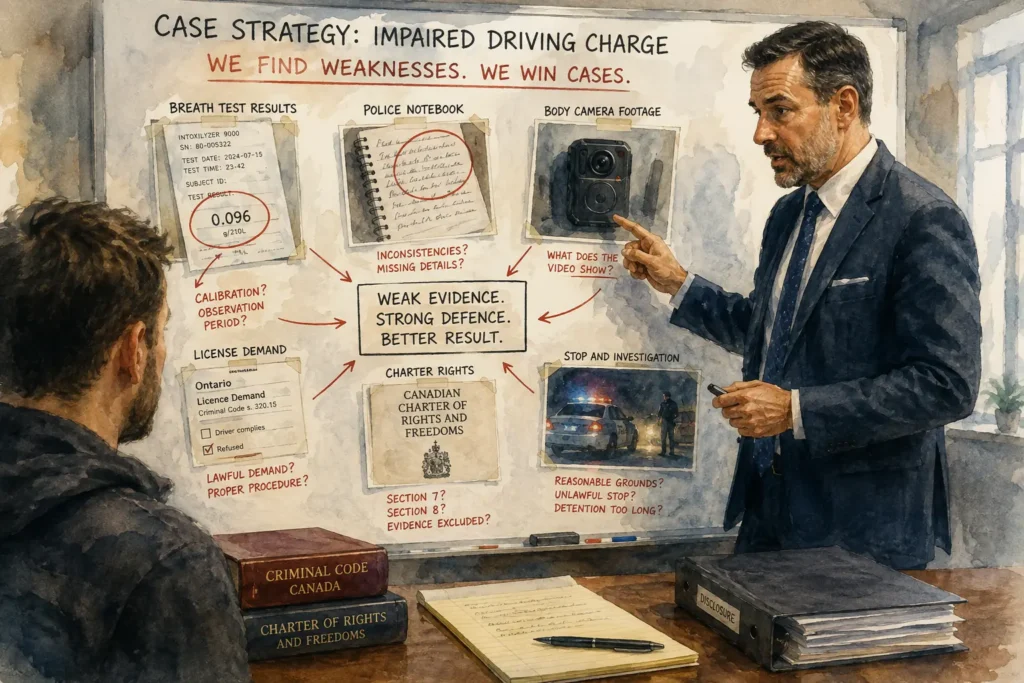
Breath test evidence is often the foundation of the Crown’s case in an impaired driving prosecution. Before those results can be relied upon in court, we carefully examine every stage of the investigation to determine whether the police followed the required procedures, whether the evidence is reliable, and whether weaknesses exist that may affect the Crown’s ability to prove the charge.
The Roadside Breath Test
The roadside investigation often determines how the remainder of the case unfolds. What happens during the first few minutes after you are stopped may become one of the most important parts of your defence.
We begin by asking questions such as:
- Why were you stopped in the first place?
- Did the officer have lawful grounds to demand a roadside breath sample?
- Did the officer properly explain what you were required to do?
- Were you shown how to use the Approved Screening Device?
- Were you given enough opportunities to provide a proper breath sample?
- If the police believed you were refusing, were you clearly warned that refusing or failing to provide a proper sample is a separate criminal offence?
- Do the police notes, body-worn camera footage, witness statements, and your version of events all tell the same story?
- Do the recorded times make sense when compared with the remainder of the investigation?
A roadside investigation that appears straightforward at first often reveals weaknesses in the Crown’s case that are not immediately obvious.
Breath Testing at the Police Station
Once you arrive at the police station, every stage of the breath testing process should follow the procedures required by the Criminal Code. We compare each document, recorded time, and breath test result to determine whether the investigation was properly conducted.
Some of the questions we consider include:
- Were you given the opportunity to speak with a lawyer before providing breath samples?
- Was that opportunity provided without unnecessary delay and in private?
- Did the qualified breathalyzer technician follow the required testing procedures?
- Was the required observation period completed before the breath tests?
- Do the times of arrest, breath demand, arrival at the police station, and breath samples all correspond with one another?
- Were there any unexplained delays?
- Were all of the required records properly completed?
Small timing errors, procedural mistakes, or inconsistencies between the records can sometimes affect the reliability of the breath test evidence.
Explaining the Certificate of Analysis
The Certificate of Analysis is a police document on which the breathalyzer technician records the result of the breath tests. This document is one of the Crown’s most important pieces of evidence in a driving over 80 prosecution.
Where the breathalyzer technician is not in court, the crown attorney must enter this document into evidence as proof of breath readings that are above the legal limit.
We examine questions such as:
- Was the Certificate of Analysis properly completed? Was a “true copy” of the document served on the accused prior to court?
- Does it match the police notes, disclosure, and breath test records?
- Was a copy properly served on the accused?
- Is any required information missing?
- If the certificate cannot be relied upon, will the qualified breathalyzer technician be required to testify and explain the testing process?
Over the years, we have seen cases where missing documents, incomplete records, or inconsistencies in the paperwork became important issues when defending impaired driving charges.
Additional Breath Test Records
The disclosure package does not always include every document relating to the breath testing process. Before advising you how to proceed, we ensure that all relevant records have been requested and carefully reviewed.
Depending on the circumstances, this may include:
- Approved Instrument maintenance records.
- Calibration and accuracy testing records.
- Breath test printouts.
- The qualified breathalyzer technician’s notes.
- Additional police records relating to the breath testing process.
By comparing these records with the police investigation, disclosure, and the remaining evidence, we look for inconsistencies, missing documentation, timing issues, and other weaknesses that may affect whether the breath test evidence can be relied upon in court.
Breath test evidence should never be accepted at face value. A careful review of the investigation often reveals problems with the evidence that are not immediately obvious but may become important when defending an impaired driving charge.
Small differences between the police notes and other evidence can identify important legal issues that may affect the defence strategy for your case.
The Roadside Investigation
The roadside investigation often determines how the rest of the case unfolds. We carefully review:
- Why the officer believed there were grounds to investigate you for impaired driving.
- Whether a roadside breath sample was requested using an Approved Screening Device and whether the proper procedures were followed.
- What the officer said, what questions were asked, and whether you understood what was being requested.
- Whether the roadside investigation complied with the Criminal Code and the Canadian Charter of Rights and Freedoms.
The roadside investigation often raises important legal issues that deserve careful review before decisions are made about your defence.
“I wish to express my deepest gratitude to Nicholas Charitsis for his support throughout this entire process. Thanks to his expertise and encouragement, the judge ruled in my favour. His availability and guidance were invaluable. A huge thank you for everything you’ve done for me!”
Challenging the Police Officer’s Evidence
Impaired driving defence begins with carefully examining the actions of the police officer
We begin by reviewing the police investigation from the initial traffic stop through to your arrest. By comparing your version of events with the police officer’s notes, witness statements, video evidence, and the Crown’s disclosure, we identify inconsistencies, weaknesses in the evidence, and legal issues that may help fight your impaired driving charge.
Police Notes and the Investigation Timeline
The investigating officer’s notes are given with the disclosure and are one of the most important pieces of evidence in an impaired driving case. The police notes are a record what the officer says happened, why the investigation began, and the observations that led to your arrest.
In reading the officers notes we’re looking at:
- Why your vehicle was stopped and whether the officer had lawful grounds to begin the investigation.
- The investigation timeline, including the time of the traffic stop, roadside investigation, arrest, rights to counsel, transportation to the police station, and other significant events.
- The officer’s observations, including your driving behaviour, appearance, speech, balance, coordination, and any signs of impairment that were recorded.
- Whether environmental factors, such as weather, road conditions, fatigue, illness, or other circumstances, may provide an alternative explanation for what the officer observed.
- Whether the police notes are complete, accurate, and consistent with the remaining evidence.
Even small inconsistencies in the officer’s notes or the investigation timeline can become important when assessing the strength of the Crown’s case.
The Roadside Investigation
The first few minutes of an impaired driving investigation often shape everything that follows. As DUI lawyers we review what occurred at the roadside to determine whether the officer’s observations are supported by the evidence.
We examine:
- What first attracted the officer’s attention to your vehicle.
- What the officer observed before approaching you.
- What was said during your roadside interaction.
- Whether your actions and responses are accurately described in the officer’s notes.
- Whether the officer’s observations are consistent with the body-worn camera footage, in-car video, witness statements, and your version of events.
The roadside investigation often provides valuable insight into how the officer reached the decision to continue the impaired driving investigation.
Video and Witness Evidence
Video recordings and witness statements often provide an independent account of what actually occurred.
We carefully compare this evidence with the police officer’s notes and the Crown’s disclosure to determine whether they tell the same story. Video evidence should support that the was impaired, and not sober.
We review:
- Body-worn camera footage.
- In-car camera recordings.
- Booking room video.
- Surveillance video where available.
- Witness statements provided to the police.
- Your appearance, speech, balance, coordination, and overall behaviour as shown on the available video evidence.
Comparing the video evidence and witness statements with the officer’s notes often reveals inconsistencies, omissions, or other weaknesses that deserve further investigation.
Court Documents and DUI Charges
The documents you receive when you are released from the police station often provide important information before the complete disclosure package is available. Reviewing these documents allows us to begin assessing your case immediately.
We carefully review:
- Your Appearance Notice, Release Order, Undertaking, or other court documents.
- The Certificate of Analysis and any breath testing documents provided by the police.
- Any Notice of Increased Punishment where the Crown intends to rely on a previous impaired driving conviction.
These release documents provide an early picture of the prosecution’s case and often help us identify issues that require further investigation once the complete disclosure package is received.
“Thank you to Vadim and Charitsis Law for all their help. My DUI charge was dropped to a careless driving ticket. It was my first experience being involved with the law, and Vadim was very informative and helpful throughout the entire process. He explained everything clearly, kept me updated, and made a very stressful situation much easier. I highly recommend Charitsis Law.”
★★★★★ Google Review
How We Build Your Impaired Driving Defence
The police believe they have enough evidence to prove the charge, but can they prove it before a judge?
Being charged with impaired driving does not automatically mean the Crown Attorney can prove the case. Before recommending how to proceed, let’s carefully examine every piece of evidence to determine whether the prosecution’s case is as strong as it first appears.
Does All of the Evidence Tell the Same Story?
Every impaired driving case is built on many different pieces of evidence. One of the first questions we ask is whether all of the evidence tells the same story. If it doesn’t, those inconsistencies may become an important part of your defence.
We carefully compare:
- Your version of what happened.
- The police officer’s notes.
- Witness statements.
- Body-worn camera, in-car camera, and booking room video.
- Breath test records and the Certificate of Analysis.
- The Crown’s disclosure.
When the evidence does not match, those inconsistencies may expose weaknesses in the Crown’s case or raise reasonable doubt at trial.
Can the Crown Actually Prove the Charge?
Every criminal defence begins with one question:
Can the Crown Attorney prove the charge beyond a reasonable doubt?
A criminal defence lawyer’s job is to identify weaknesses raise or put a reasonable doubt in the judge’s mind. Where a reasonable doubt exists, the judge must find you not guilty.
Subsequently, as DUI lawyers, we’re looking for:
- Inconsistencies between the police officer’s notes, witness statements, and video evidence.
- Missing or incomplete disclosure.
- Gaps or unexplained delays in the investigation.
- Weaknesses in the officer’s observations.
- Problems affecting the reliability of the breath test evidence.
- Charter issues that may affect whether evidence can be used in court.
Every weakness we identify helps us determine the strongest defence strategy for your case. Every weakness further builds reasonable doubt in the judge’s mind.
Step One – Reviewing the Evidence
Before recommending a defence strategy, we carefully review the disclosure, police investigation, breath test evidence, witness statements, video recordings, and every other available piece of evidence. Our goal is to identify every legal argument that may help challenge the Crown’s case.
Step Two – The Crown Pre-Trial
Once the evidence has been reviewed, we meet with the Crown Attorney for a Crown pre-trial to discuss the strengths and weaknesses of the case. This is often the first opportunity to determine whether the matter can be resolved without a trial.
During the Crown pre-trial, we consider:
- Can the charge be withdrawn?
- Is a reduced charge available?
- Is additional disclosure required?
- Is further investigation needed?
- Should the matter proceed to trial?
Many impaired driving cases are successfully resolved during this stage of the proceedings.
Step Three – Preparing for Trial
If your case cannot be resolved, we begin preparing for trial. This is where years of courtroom experience become important.
We organize the evidence, research the relevant impaired driving case law, prepare legal arguments, develop a cross-examination strategy, and determine the most effective way to challenge the Crown’s evidence before the trial judge.
Recent Impaired Driving Successes
These cases show how legal issues can change the outcome of a DUI charge.
These real court decisions show how legal issues, careful preparation, and strong defence strategies have helped our clients successfully fight impaired driving charges.
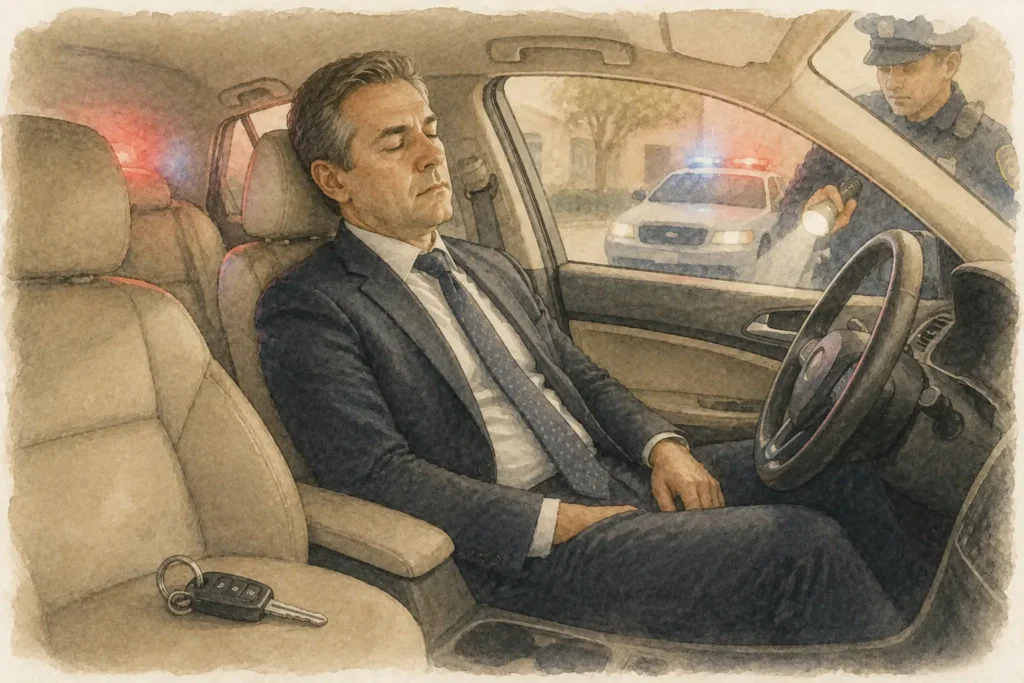


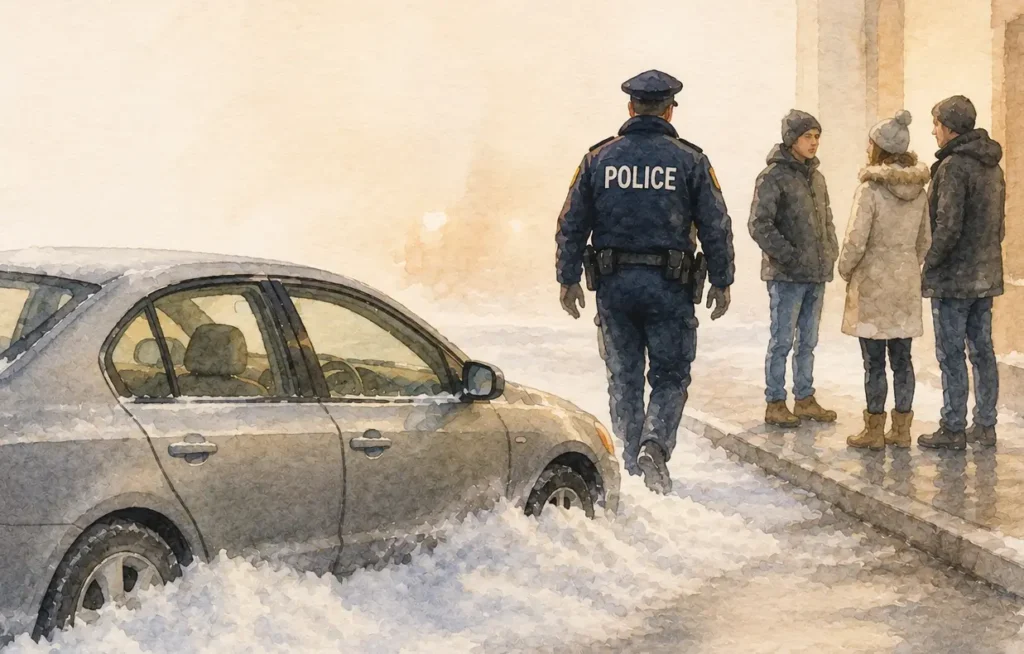
These are just a few examples of how legal issues have helped our clients successfully fight impaired driving charges. Every case is different, and the outcome depends on the evidence, the legal issues involved, and the defence strategy.
View More DUI Cases We’ve Won →
Why People Charged With DUI Choose Charitsis Law
- ✓Chair, Ontario Judicial Appointments Advisory Committee
- ✓Chair, Ontario Justices of the Peace Appointments Advisory Committee
- ✓Former Crown Attorney leading the defence strategy
- ✓25+ years of criminal & DUI defence experience in Ontario courts
- ✓Senior Toronto DUI lawyers defending impaired driving charges
- ✓Hundreds of Winning Google reviews from former clients with similar cases
- ✓Speak directly with Nicholas Charitsis about your case
- ✓No-cost initial consultation before you decide what to do next
Serving Clients Across the Greater Toronto Area and Central Ontario
If you are facing a DUI or any drinking and driving charge, Charitsis Law represents clients throughout Southern Ontario. Meet with an experienced criminal defence lawyer at our offices in Brampton, Oshawa, Aurora, Newmarket, or Muskoka, or contact us to discuss your case and the court process.
Speak With Nicholas Charitsis Today
You’ll speak directly with Nicholas Charitsis—not a call centre or an intake representative.

When you call Charitsis Law, you’ll speak directly with Nicholas Charitsis. He’ll answer your questions, explain your legal options, and help you understand the evidence against you.
Call 416-731-7113 today to arrange your confidential case review.
Questions About Hiring a DUI Lawyer
These are some of the most common questions people ask before hiring an impaired driving lawyer in Ontario.
Q. How Do I Choose the Right DUI Lawyer?
A. Choosing a DUI lawyer is one of the most important decisions you’ll make after being charged. Look for a lawyer who regularly defends impaired driving cases, has extensive criminal defence experience, and can clearly explain the evidence and your legal options.
Ask whether you’ll speak directly with the lawyer handling your case, whether they have trial experience, and how they develop a defence strategy. A good lawyer should answer your questions honestly and explain both the strengths and weaknesses of your case.
Don’t choose a lawyer based on price alone. Experience, preparation, and judgment can make a significant difference in how your case is handled.
If you’re comparing lawyers, we recommend reading our guide on how to choose the right DUI lawyer before making your decision.
Q. How Much Does It Cost to Hire a DUI Lawyer?
A. The cost of hiring a DUI lawyer depends on the facts of your case. Some impaired driving charges are straightforward, while others involve Charter arguments, expert evidence, or a trial. Those factors can affect the legal fees.
Ask whether the lawyer charges a fixed fee or bills by the hour. You should also ask what services are included and whether the quoted fee covers a trial if one becomes necessary.
Choosing a lawyer based on price alone can be a costly mistake. Experience, preparation, and the right defence strategy often have a greater impact on your case than finding the lowest fee.
If you’d like to learn more, read our guide on DUI lawyer fees and legal costs before making your decision.
Q. Why Was I Charged With Both Impaired Driving and Over 80?
It’s common for police to lay more than one impaired driving charge after the same incident. For example, you may be charged with both impaired driving and having a blood alcohol concentration over the legal limit. While the charges arise from the same event, each requires the Crown Attorney to prove different legal elements.
Being charged with two offences does not mean you’ll receive two convictions. In many cases, only one conviction can be entered if both charges relate to the same incident.
An experienced DUI lawyer will review the evidence supporting each charge, identify any legal issues, and determine whether one or both charges can be challenged.
Q. What’s the Difference Between Impaired Driving and Care and Control?
Many people think you can only be charged if the police see you driving. That’s not always true.
An impaired driving charge usually involves allegations that you were operating a motor vehicle while impaired. A care and control charge applies when the police believe you had the ability to operate the vehicle, even if it wasn’t moving.
For example, a person sleeping in the driver’s seat with the keys nearby may be investigated for care and control. Whether the Crown Attorney can prove the charge depends on the evidence and the specific circumstances of the case.
To learn more, read our guide on Impaired Driving Care and Control Charges.
Q. Can Any DUI Lawyer Guarantee They’ll Win My Case?
No. An honest DUI lawyer will never guarantee that your charges will be withdrawn or that you’ll be found not guilty. Every impaired driving case is different, and the outcome depends on the evidence, the legal issues, and the facts of your case.
A good DUI lawyer will carefully review the Crown’s evidence, explain the strengths and weaknesses of your case, and recommend the defence strategy that gives you the best opportunity for success. Then they can give you their opinion as to whether they can win the case.
Be cautious of any lawyer who promises a specific outcome before reviewing the evidence. Experience matters, but so does honesty. You deserve straightforward legal advice based on the facts of your case.